This site uses two first-party cookies: one to keep you signed in, and one that remembers how you first arrived here (for our own basic stats, never shared with anyone else). No third-party tracking or advertising cookies.
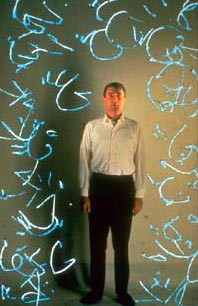
Brion Gysin (January 19, 1916 in Taplow, Buckinghamshire, UK - July 13, 1986 in Paris, France) was a writer and painter.
He is best known for his rediscovery of Tristan Tzara's cut-up technique while cutting through a newspaper upon which he was trimming some mats. He shared his discovery with his friend William S. Burroughs, who subsequently put the cut-up technique to good use and dramatically… Read morechanged the landscape of American literature.
Educated in England, at Downside College (1932-34), he moved to Paris where he studied at the Sorbonne. Among those he met at this time are renowned members of the Surrealist group, including Max Ernst, Salvador and Gala Dali and Picasso. Gysin’s work was included in the Surrealist Drawings exhibition in Paris in 1935 (Galerie Quatre).
He first visited the Algerian Sahara in 1938, a journey that was to have a deep and lasting influence on his life. Equally significant to the form of his later giant landscape paintings were the years he spent in New York working as assistant to Broadway stage designer Irene Sharaff (1940-43). In 1953, having returned to North Africa, Gysin opened the Thousand and One Nights restaurant, where the Master Musicians of Joujouka played an ‘extended residency’.
Gysin altered the cut-up technique to produce what he called permutation poems in which a single phrase was repeated several times, with the words rearranged in a different order with each reiteration. Many of these permutations were derived using a random sequence generator in an early computer program written by Ian Sommerville.
He also experimented with permutation on recording tape, by splicing together the sounds of a gun firing recorded at different amplitudes in the BBC Radiophonic Workshop thus producing 'Pistol Poem.' The piece was subsequently used as a theme in 1960 for the performance in Paris of Le Domaine Poetique, a showcase for experimental works by people like Gysin, Françoise Dufrêne, Bernard Heidsieck, and Henri Chopin.
The whole trance scene, connected. Real artists, no AI music.
Catalogue data provided by Discogs. This application uses the Discogs API but is not affiliated with, sponsored or endorsed by Discogs. “Discogs” is a trademark of Zink Media, LLC. Additional catalogue data from MusicBrainz.
Chart and release information referencing Beatport is shown for reference only; this application is not affiliated with, sponsored or endorsed by Beatport LLC, and “Beatport” is a trademark of its respective owner. Cover art and track matching also draw on the Spotify platform; this application is not affiliated with, sponsored or endorsed by Spotify AB, and “Spotify” is a trademark of its respective owner.
Get the appScan with your phone camera to put TranceHQ on your home screenHow it works →
TranceHQ on your phoneFree, no app store needed
We use cookies to keep you signed in and, if you accept, to see which parts of TranceHQ people use so we can make it better. Never sold, never used for ads.